UK Horse Racing Bet Types: House Edge and Returns
 Available in US
Table of Contents
- House Edge Mathematics Across UK Racing Bet Types
- Singles, doubles and trebles — the building blocks
- Accumulators: math, marketing and where the edge goes
- Trixie, Yankee, Patent, Lucky 15, Lucky 31, Heinz, Super Heinz, Goliath
- Tote pools: Placepot, Jackpot, Scoop6
- Forecast, tricast and quinella — finishing-order bets
- Back, lay and trading on the exchange
- Without favourite, match-bets and specials
- Which bet type fits which race
- Frequently asked questions
- The bet that buys what you actually want
House Edge Mathematics Across UK Racing Bet Types
The most expensive thing I’ve ever ordered in a betting shop was a Goliath. I was nineteen, I had eight selections at average prices around 3/1, and I worked out — with the optimism of nineteen-year-olds — that I needed barely half of them to come in for the bet to make sense. The bet cost me £247 in lines. Four selections won. I collected £63. I learned more about bet types from that one slip than from a year of pretending to study form.
Here’s the thing nobody really explains in the explainer guides. Bet type is not a payment method. It’s not the way you “fancy” a race versus a tip you’re cold on. Bet type is the single biggest lever you pull on your effective house edge — bigger than your selection skill, bigger than your discipline on stake sizing, bigger than which bookmaker you use. Stack legs in an accumulator and you stack the operator’s margin. Build a Yankee and you’re paying for combinations you didn’t necessarily want. Lay on the exchange and you’re paying commission instead of margin. Three different mechanisms, three completely different mathematics, all sitting under the same “betting” umbrella.
This is also why pari-mutuel — the Tote pool that sits outside the fixed-odds bookmaker model — accounts for only around 5% of UK racing turnover. It’s a different mathematical engine, and most British punters never engage with it. The fixed-odds side, where everything you see on a bookmaker shelf lives, is where 95% of the volume sits. Understanding which fixed-odds construction does what is the single highest-leverage thing a UK punter can learn.
The structure of this guide follows the rough ladder of complexity. We start with singles. We finish at the exchange. Along the way we’ll calculate a Heinz, work out why a Lucky 15 is mathematically a four-selection bet that costs you 15 stakes, and look at the case for the much-maligned forecast. By the end you should have a clear answer to a question most punters never ask themselves: what is this bet actually buying me, and at what margin?
Once you understand the basics of singles and multiples, it is crucial to master the mathematics behind an each-way bet in UK horse racing to maximize your returns.
Singles, doubles and trebles — the building blocks
Everything in fixed-odds racing builds from the single. A single is a bet on one outcome at one price. £10 at 5/1, the horse wins, you collect £60 — your £50 profit plus your tenner back. The implied probability of 5/1 is 16.67%, the operator’s typical margin on a ten-runner handicap rolls the book to about 112%, and your effective edge against the operator is whatever your handicapping is worth against that overround. That’s the entire mathematics. Every other bet type in this guide is some combination, multiplication or rearrangement of singles.
The double multiplies two singles. If your two horses both go in at 5/1 and 3/1, your £10 stake returns £10 × 6 × 4 = £240. The treble adds a third leg — £10 at the same prices plus a 4/1 third leg returns £10 × 6 × 4 × 5 = £1,200. The progression looks beautiful on the slip. The problem is the implied probability: a 5/1, 3/1, 4/1 treble has a true-probability hit rate of about 1.04% if every price is fair, which on a typical UK handicap book it isn’t. Every leg you add multiplies the overround as well as the prices.
The double, the treble, the four-fold and the multi-leg accumulator are sometimes called straight multiples to distinguish them from the system bets we’ll come to. They share one feature: every selection must win for the bet to return. One non-runner reduces the bet by a leg; one loser kills it.
The everyday use case for the straight multiple in UK racing is the Saturday acca on a televised card — four or five selections across the ITV meetings, each running between 2/1 and 6/1, with the punter accepting a roughly 1-in-50 hit rate in exchange for a triple-digit return. It’s a valid recreational structure as long as the punter is honest about the maths. Add a leg and you don’t just lengthen the price — you change what you’re buying. By a 7-fold the operator’s overround has compounded to the point where the effective margin is closer to a casino game than a punt. That’s not a moral problem. It’s just the maths to be aware of.
Accumulators: math, marketing and where the edge goes
Let me show you the compounding properly because most punters never work it through. Imagine an operator running a clean 110% book on every single race — well below the actual British average for big-field handicaps. On a single, the punter is giving up 10% of expected value to the operator at the off, before BOG and before any settlement adjustment.
Now stack two of those races into a double. The operator’s book on the combined event isn’t 110%. It’s 1.10 × 1.10 = 121%. Three races compounded is 1.10³ = 133%. Five races is 1.61, meaning the operator’s effective edge has compounded to 61% of expected value gone — even before considering that handicap markets typically price closer to 112–115% than 110%, and that the punter’s selection skill is being tested across five independent events.
This is why a five-fold acca looks like a great-value product on the slip and is, in fact, a high-margin product for the operator. The structure of the bet builds the operator’s edge through the leg count. The operator wins nothing extra on any single race — it’s the same trader pricing the same race. What the operator wins is the accumulating margin on the joint settlement.
The promotional layer that operators bolt onto multiples — Acca Insurance, Acca Boost, “one leg lets you down” money-back — exists because operators know this. The Insurance promotion typically refunds your stake if one selection lets you down on a four-fold or longer. The Boost adds a percentage to your odds the more legs you stack. Both promotions are funded out of the compounding margin we just calculated, and both shift the value back toward the punter in ways that, on the bigger books, can roughly cancel the leg-count overround.
The practical version of all this: a four-fold or longer should always be placed on an account where the operator runs Acca Insurance or equivalent. The promotion doesn’t make the bet good. It makes the bet less mathematically punitive. Place the same four-fold somewhere without the promotion and you’re funding the operator’s compounded margin out of your own value.
Trixie, Yankee, Patent, Lucky 15, Lucky 31, Heinz, Super Heinz, Goliath
The system bets are accumulators broken into their constituent doubles, trebles, four-folds and so on. They’re the British contribution to the global betting vocabulary — most of them named after the Heinz “57 varieties” branding from the 1950s — and they’re built around a simple promise: you don’t need every selection to win for the bet to return something.
A Trixie is three selections, three doubles, one treble — four bets in total. £1 unit-stake means £4 total stake. A Yankee is four selections, six doubles, four trebles, one four-fold — eleven bets, £11 unit-stake. A Patent adds the singles to a Trixie: three selections, three singles, three doubles, one treble — seven bets, £7 unit-stake.
The Lucky 15 is the Yankee with singles added — four selections, four singles, six doubles, four trebles, one four-fold, fifteen bets in total. The Lucky 31 is the same idea with five selections — five singles, ten doubles, ten trebles, five four-folds, one five-fold, 31 bets. The “Lucky” prefix exists because most bookmakers attach a bonus structure: typically double odds on a single winner and a percentage boost on all-winning bets.
Then the multi-selection systems get expensive. A Heinz is six selections in 57 lines — 15 doubles, 20 trebles, 15 four-folds, 6 five-folds, 1 six-fold. £1 unit-stake costs £57. A Super Heinz is seven selections in 120 lines. The Goliath I bought as a teenager is eight selections, broken into 247 doubles-to-eight-folds — £247 at a £1 unit-stake, with no singles, meaning any selection winning on its own returns nothing.
| Bet name | Selections | Lines | Cost at £1 unit |
|---|---|---|---|
| Trixie | 3 | 4 | £4 |
| Patent | 3 | 7 | £7 |
| Yankee | 4 | 11 | £11 |
| Lucky 15 | 4 | 15 | £15 |
| Canadian | 5 | 26 | £26 |
| Lucky 31 | 5 | 31 | £31 |
| Heinz | 6 | 57 | £57 |
| Lucky 63 | 6 | 63 | £63 |
| Super Heinz | 7 | 120 | £120 |
| Goliath | 8 | 247 | £247 |
The maths question that matters: are system bets better-value than the equivalent number of singles? The answer is structurally no. A Lucky 15 is a £15 outlay on which you cannot win unless you’ve correctly picked between one and four horses, and on which the operator’s overround compounds across every double, treble and four-fold leg you’ve effectively backed. The £15 of singles you could have placed instead carries one unit of overround per race. The Lucky 15 carries the overround compounded across fifteen separate bets.
So why are system bets so popular? Because they win something on most outings. The hit rate on a Lucky 15 with four 3/1 selections is roughly 90% — that is, on roughly 90% of slips at least one selection wins. The punter feels engaged. Most slips return something. The fact that the expected value across many slips is materially worse than the equivalent singles is invisible inside any one round. This is the design problem with system bets: they trade long-run value for short-run engagement, and the operator’s marketing leans heavily into the latter.
If you’re using system bets — and many punters reasonably are, because the entertainment value is real — the case for the Patent and the Lucky 15 over the Trixie and the Yankee is the singles inclusion. A bet that returns nothing on a single winner is a system bet at its purest and worst, because you’ve paid for combinations that need at least two of your selections to win before any return appears.
Tote pools: Placepot, Jackpot, Scoop6
The Tote is the British implementation of pari-mutuel betting. Stake goes into a pool. Winners share the pool after the operator’s takeout. The price you get isn’t fixed at the off — it’s determined by how much money is on each runner in the pool and the size of the takeout. Tote turnover sits at about 5% of UK racing volume; the casual punter never engages, the festival-day punter often does, and the regular UK racing bettor uses the Tote selectively for specific products.
The Placepot is the headline Tote product and the only one most punters ever try. The bet is to select a placed horse in each of the first six races at a UK meeting. “Placed” follows the Tote’s own place definition, which is typically the first three home in a field of 8+ or first four home in handicaps of 16+. Take a single line at £2 and you’ve made one bet across six races; perm your selections — two horses in two of the legs, three in another — and the cost multiplies but so does the cover. The dividend is announced once the sixth race settles and depends entirely on how many slips made it through.
The Jackpot extends the same idea to picking the winner of every race in a meeting’s first six. The hit rate is brutal — the typical Jackpot pool runs over from day to day until a slip hits — and the dividends, when they hit on a rollover, can run into six figures. The Scoop6 is the same logic across six televised races on a Saturday rather than a single meeting. Both share the same essential structure: low hit rate, lumpy payouts, rollover dynamics that make a dry Saturday’s pool a meaningful prize fund for the day it eventually hits.
The mathematical case for the Tote against a fixed-odds book varies by race. On the headline handicap of a major festival, where the public money distorts the SP — heavy support on a famous name, professional money on a recent winner — the Tote sometimes outprices the fixed-odds book by a meaningful margin. On the everyday Class 5 Wolverhampton card, the pool is too thin for the dividend to reflect anything except the operator’s takeout, and the fixed-odds book typically wins on price. Pool turnover scales the value: bigger pools, sharper dividends.
Forecast, tricast and quinella — finishing-order bets
The forecast and tricast sit in their own awkward corner of the UK market. The forecast asks you to pick the first two home in correct order; the tricast asks you to pick the first three in correct order. The bet pays a single dividend at settlement, calculated under the Computer Straight Forecast (CSF) formula — a published method that accounts for the SPs of the placed horses and the field size.
The reverse forecast covers both orderings of two selections — £1 each way costs £2 — and pays whichever combination wins. The combination forecast permutes more than two horses across the first two finishing positions — three horses combination forecast costs six unit-stakes (3 × 2 ordered pairs) and pays whichever pair finishes first and second. The tricast equivalents scale similarly: a three-horse straight tricast costs one stake unit, the combination tricast across three horses costs six (3 × 2 × 1), and across four horses costs 24.
The honest assessment of finishing-order bets is that they’re an entertainment product with a punishing operator edge. The CSF formula bakes in a takeout that, compounded across the combinatorial cost of the bet, makes the effective margin on a four-horse combination tricast genuinely casino-level. The exception is the narrow case where the punter has a strong, contrarian view on a likely 1-2 — particularly on stable-mate pairings in big-handicap conditions races — and the SPs of the placed horses produce a CSF dividend that the punter has genuinely outpriced. That’s a rare set of conditions. For most cards, the forecast and tricast are products to admire rather than products to play.
For more daily insights and expert analysis, visit the top UK horse racing betting guide.
Back, lay and trading on the exchange
The exchange is where I do most of my serious betting these days, and the reason isn’t ideology — it’s mathematics. The exchange replaces the operator’s traded margin with a flat commission on net winnings, typically 2% to 5% depending on operator and customer tier. That’s a different cost structure entirely, and it shapes a different kind of bet.
The back bet on the exchange works the way a fixed-odds bet works on a sportsbook. You back a horse at a price; if it wins you collect, less commission. The difference is the price — the back side of the exchange ladder shows the best price someone else is willing to lay, and that price is usually fractionally better than the same race on a sportsbook because there’s no trader margin built in.
The lay bet is the new function. Laying a horse is taking the position the bookmaker would take — accepting a stake from someone else at a price, and paying out if their selection wins. £10 to lay a horse at 5/1 means you’re risking £50 (the liability) to win the £10 stake. The exchange holds the liability on your behalf at the point of bet placement, and releases it back when the race settles.
The trading dimension is where it gets interesting. In-running pricing on a UK race typically moves rapidly between the off and the finish — favourites drift to 1.5 from 2.0 as they go to post, shorten back to 1.3 a furlong out, drift again as a market move appears on the rail. A trader can back at a longer price and lay at a shorter price for a guaranteed profit (“greening up”) regardless of the eventual winner. The skill is in reading the in-running market faster than the book, which on UK racing is mostly a question of practice.
The exchange market hasn’t grown lately. GGY on UK exchanges fell from £161 million in 2019–20 to £124 million in 2021–22 — a 23% drop. The cause isn’t the exchanges getting worse. It’s the regulatory squeeze on the high-stake audience that exchanges historically serve. The same wave of financial vulnerability checks that brought the £150 threshold in February 2025 hit the exchange high rollers first, and many moved offshore. The Betting and Gaming Council’s read on the migration is that asking punters for bank statements isn’t frictionless in any meaningful sense — it’s an intrusion that pushes customers toward the unregulated market where no safeguards exist. The exchange GGY decline is the regulated-market footprint of that movement.
Without favourite, match-bets and specials
The without-favourite book is the most useful niche market in UK racing and the one most casual punters never use. The principle is simple: the bookmaker prices the race assuming the favourite isn’t running, and you pick the winner from the remaining field. The market is offered on cards with strong favourites — say, a 6/4 jolly with no obvious alternative — where the prices in the main book are compressed.
The mathematical case for without-favourite is that the implied probability of the favourite winning, typically 35–50%, gets removed from the book and the remaining probability redistributes across the rest of the field. A 7/1 third-favourite in the main book might price up at 7/2 in the without-favourite. If your view is that the favourite is over-rated — which on plenty of UK handicaps it is, because once-a-year punters back the name — the without-favourite book is the cleanest expression of that view.
Match bets — head-to-head selections between two horses in a race, settled on which crosses the line first — are the racing equivalent of football’s match-result markets. They work best on conditions races and Group races where the field is small enough that match-up pricing makes sense, and where the punter has a view on the head-to-head that the bookmaker hasn’t fully priced.
The “specials” category covers everything from “named jockey to win on day 1 of Royal Ascot” to “horse to win by N lengths” to “trainer to have most winners across the meeting”. These markets carry wide overrounds because they’re traded on small samples — the operator can’t model the probability tightly, so they pad. Specials are entertainment products. Treat them that way.
Which bet type fits which race
The framework I work to is rough but consistent. The smaller the field and the sharper the favourite, the better the single. The bigger the field and the noisier the form lines, the better the each-way and the lower the value of the multiple. Festivals — Cheltenham, Aintree, Royal Ascot — change the rules because the operator’s marketing overrides the maths: extra places, BOG promotions and money-back specials at festivals shift the effective margin back toward the punter in ways that an everyday card doesn’t replicate.
On a typical UK midweek handicap — ten runners, a 4/1 favourite, prices spread from 3/1 to 25/1 — the single is the cleanest expression of a view. If you have a sharp favourite you fancy at the same price as the SP, you’re effectively betting against the public money rather than against the operator. The exchange improves the price marginally; the sportsbook gives you BOG. Both are reasonable routes.
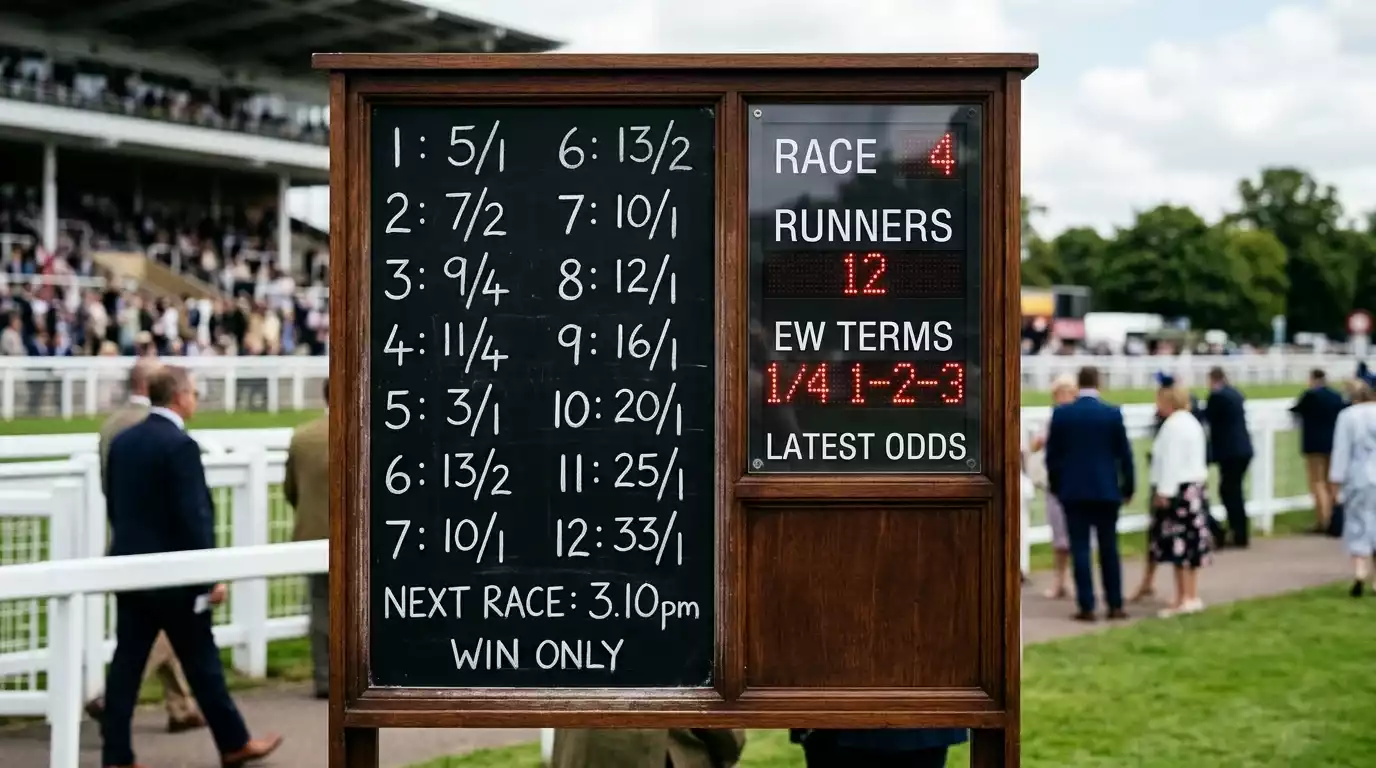
On a 20-runner handicap, the each-way starts to make sense — the place fraction of 1/4 at four places gives the punter a separate place-side bet at a sensible probability, and the overround on the place market is sometimes meaningfully tighter than the win market. The full mechanics of each-way betting, place fractions and Rule 4 deserve their own treatment because the maths varies by race type.
On the headline festival card — Cheltenham Champion Day, Grand National Day, the Royal Ascot Tuesday — the operator marketing is loud enough that the multiple becomes a less-bad bet than usual. Acca Insurance, extra places on every handicap, BOG on every race, money-back specials on placed horses. The Lucky 15 across four festival selections, placed on a site running aggressive promotions, isn’t the value-pit it would be on a Tuesday at Newcastle.
Richard Marsh at OLBG made a useful observation about the rest of the audience: “Unlike other popular racing festivals, the Grand National appeals to ‘once-a-year’ punters, which highlights why 51% of UK adults who are planning to bet on the Grand National say they pick their horse by name, 36% by gut feeling and 14% by colour.” If you’re a regular, the once-a-year audience is the public money you’re trading against — and the bet type you pick should reflect the asymmetry of being a regular at someone else’s party.
Frequently asked questions
Why is a Lucky 15 more popular than four singles?
Because the engagement rate is higher even though the expected value is structurally worse. A Lucky 15 returns something on most slips where at least one selection wins, and the operator’s bonus terms — typically double odds on a single winner — make the partial returns feel rewarding. Four singles return only on winning races, which loses more often but gives back the operator margin you’d otherwise pay on the system bet’s compounding legs. The maths favours the singles; the psychology favours the Lucky 15.
What happens to a system bet if one selection is a non-runner?
The non-runner is treated as void at SP, and the bet is recalculated as if it were never on the slip. A Yankee with one non-runner becomes a Trixie on the remaining three selections, with the original Yankee stake redistributed across the new Trixie’s four lines. A Lucky 15 with one non-runner becomes a Patent on three selections — three singles, three doubles, one treble. The operator handles the recalculation automatically; the punter sees an updated bet on the slip after the non-runner is declared.
Can I cash out an each-way multiple?
Some operators allow it, most don’t, and the value of the offered cash-out price is typically worse than the equivalent on a straight multiple. The cash-out calculation on an each-way multiple has to value two separate bets in parallel — the win side and the place side — across all the lines of the multiple, and the operator builds extra margin into the offered price to cover the modelling complexity. If your operator offers each-way cash-out, treat the offered price with scepticism.
The bet that buys what you actually want
The temptation when you’ve finished reading a structural breakdown like this is to treat every bet as a maths problem. It isn’t. The system bets, the festival multiples, the once-a-year Goliath — they exist because betting is partly entertainment, and the engagement structure of a Lucky 15 across four ITV selections is genuinely rewarding even when the expected value isn’t. The honest thing to do is to know which bet you’re buying and why, and to size the stake to the entertainment rather than to a returns model that the operator’s overround is going to outpace. Match the bet to the race, match the stake to the bet, and the rest takes care of itself.
Written by the editors at Bets Horse Racing.