Grand National 2026 Odds: Aintree Place Terms and Betting
 Available in US
Table of Contents
- Aintree Grand National Structural Betting Rules and Anomalies
- The race: 34 fences, 4¼ miles, 34–40 runners
- Place terms unique to Aintree
- Reading the 2026 ante-post market
- How 13 million people actually bet
- Sensible staking when you only bet once a year
- Promotions: extra places, money-back specials, BOG window
- The £10 million black-market problem on GN day
- 2025 attendance, viewership and what 2026 looks like
- Frequently asked questions
- Watching the race rather than the slip
Aintree Grand National Structural Betting Rules and Anomalies
The argument I have most often, the week before Aintree, is with the same friend every year. He doesn’t bet on racing. He doesn’t watch racing. He couldn’t tell you which trainer Willie Mullins is — though he could, if pressed, name three horses from the Cheltenham Festival because he caught the last day on the pub TV. And every April he asks me for a tip on the National, places £20 on the name I give him, and watches the race with a stake that’s roughly his weekly coffee budget. He is, by some distance, the median Grand National punter.
Around 13 million UK adults bet on the Grand National in a typical year — roughly a third of the adult population, dwarfing the regular UK racing audience by an order of magnitude. The race sits outside every other framework in UK betting because the audience betting on it is unlike the audience for any other British sporting event. The Boat Race, the FA Cup Final, the London Marathon — none of them comes close to the National’s reach into the casual sporting calendar.
The result is a betting market that doesn’t behave like the rest of the racing book. Prices compress on horses with memorable names. The favourite often drifts in the morning because the public money is on the third-favourite by name recognition. Extra-place promotions push the place count to six and seven, which on a 34-to-40 runner handicap rewrites the each-way maths entirely. The bookmaker’s marketing budget on the day outstrips the trading margin by a meaningful multiple. Everything that’s true about a midweek 10-runner handicap at Carlisle is false about the National.
This guide is built for two audiences sitting on the same page. The regular punter looking to trade against the once-a-year market — and to understand where the value concentrates when 13 million casual bets distort the prices in predictable ways. And the once-a-year punter who’d rather understand what they’re betting on than pick the prettiest name on the slip. Both audiences are reading the same race; both are reading completely different markets within it.
Before placing your wagers on the big day, make sure to read our comprehensive Aintree Grand National betting guide to understand the unique challenges of this 34-runner field.
The race: 34 fences, 4¼ miles, 34–40 runners
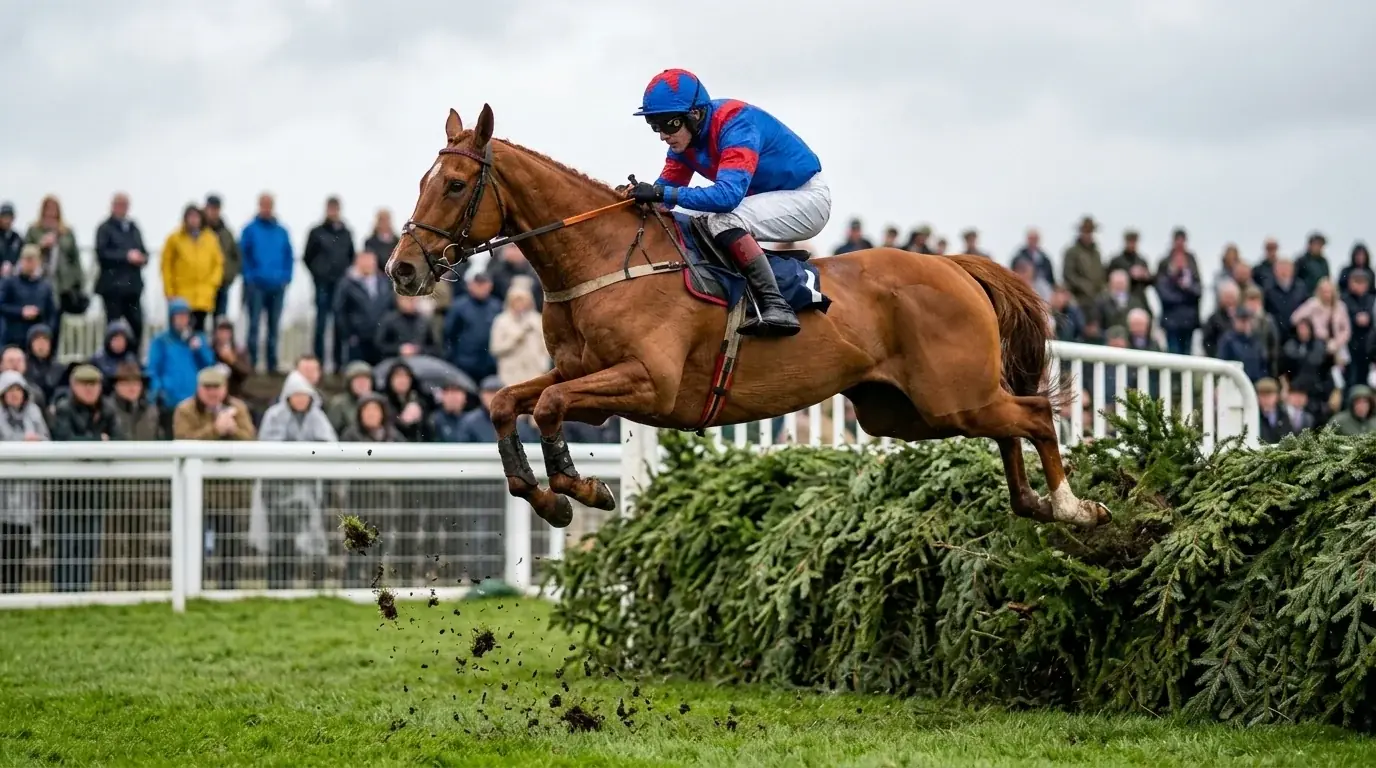
The Grand National itself is the longest mainstream race in British jump racing. Four miles, two and a half furlongs around two circuits of Aintree’s National Course. Thirty fences on the first circuit reducing to sixteen on the second after the chase passes through the inside running on the final lap. The Chair — fence 15 — is the largest and most awkward of the obstacles, with a six-foot ditch on the take-off side. Becher’s Brook at fence six, with the drop on landing that gives the race much of its character.
The field cap was reduced from 40 to 34 runners for the 2024 edition following the Jockey Club’s safety review, with a further series of fence modifications to reduce attrition at the early obstacles. The race carries the highest prize money in British jump racing — a £1 million total fund with around £580,000 to the winner in recent editions. The hosting structure has shifted across recent years to align with the BHA’s Premier Fixtures programming, which means the race itself is now bundled with two days of supporting card that carry their own Class 1 and Class 2 races and their own betting volumes.
The horses entered for the National have to satisfy a series of qualification rules — minimum age of seven, minimum prior chase experience, official rating typically above a 140 cut-off line. The handicapper assigns weights based on a published rating, with the top weight carrying 11st 10lb and weight reducing across the field to a minimum that historically sat around 10st 0lb. The handicap structure compresses the field’s running ability into a quasi-pari-mutuel race shape — each horse’s chance is broadly comparable, which is why the prices spread from a 6/1 favourite to 100/1 outsiders without huge gaps in the middle of the book.
The going on race day shifts the field’s complexion materially. Good-to-soft going favours horses with proven stamina; heavy going produces attritional races where the front-running outsider can run a meaningful race. The going is published on the morning of the race and is the single most important input to ante-post and day-of-race betting alike. Backing the race in March with no view on the April weather is a leap that costs the ante-post punter regularly.
Place terms unique to Aintree
The Grand National’s place market is the most generous in UK racing by an obvious margin. The Tattersalls’ table mandates four places paid on any 16+ runner handicap, but operator promotion at the National has pushed the count up to five, six and seven places on most major operators for the last several years running. The 2025 edition saw most headline bookmakers paying at least five places, with several extending to seven.
The mathematics behind extra places at the National are unusually punter-favourable for several reasons. The field of 34–40 runners means the implied probability of any individual horse hitting the place market is structurally compressed — the probability of finishing in the top four out of 34 is meaningfully lower than the probability of finishing in the top four out of 12, for the same-quality horse. Pushing the place count to six redistributes that compressed probability back toward the punter without the operator getting equivalent compensating margin from elsewhere in the book.
The place fraction at the National follows the standard 1/4 odds for handicaps with 16+ runners. Combined with the extended place count, the math on a £10 each-way at 25/1 with six places paid looks like this: the win side stakes £10 at 25/1, returns £260 if the horse wins; the place side stakes £10 at 25/4 (one-quarter of 25/1), returns £72.50 if the horse finishes anywhere in the top six. Total maximum return on a winning bet: £332.50. Total return on a placed-not-won bet: £72.50. The place-side return on a placed bet is more than three times the original outlay, which is the structural reason the each-way is the default at the National.
The catch is that the extra-place promotion isn’t compounded with BOG on the place side — the place dividend is calculated on the place fraction of the win price taken at bet placement, regardless of whether BOG kicks in on the win side at the off. The promotion also doesn’t propagate to ante-post bets in most cases — extra places are typically a day-of-race or week-of-race promotion rather than an ante-post offer.
For the broader picture of how place terms shift across UK festivals, the each-way mechanics work through the structural maths in detail. The National sits at one extreme of that spectrum, with operator competition pushing the place count beyond anything the Tattersalls table would mandate.
Reading the 2026 ante-post market
The 2026 ante-post market opens in late spring 2025 — typically the day after the previous National concludes — and prices firm into the autumn as the qualifying season for the race takes shape. The market’s information content shifts across the year. In May and June the prices are essentially a futures bet on horses with prior Aintree form and likely 2026 entries. By December, the qualifying picture for the race has clarified, weights are published in February, and the market becomes a meaningful read on the actual race shape rather than a long-range guess.
The structure of the ante-post market makes it economically interesting because it bakes in three distinct risks: the horse not running, the horse failing to qualify, and the horse’s form deteriorating between price-taking and race day. The first risk is mitigated by non-runner-no-bet promotions that operators offer in the final week or two before the race — once a horse is declared an NRNB pick, your ante-post bet returns the stake if the horse doesn’t run. The second and third risks are part of the price.
The headline number to anchor the 2026 market is the William Hill projection for the wider racing turnover environment: roughly £450 million across the four days of the 2026 Cheltenham Festival, on the operator’s own forecasting. The National is a one-day event rather than a four-day meeting, but the share of UK betting volume that lands on the National Friday and Saturday rivals the entire Cheltenham fortnight in single-day intensity. The pricing implications are structural: operators run aggressive book balances on the National because they have to, and the morning prices typically reflect a tighter overround than equivalent races elsewhere on the racing calendar.
The Cheltenham Festival 2025 turnover data gives a useful comparison. All 28 races at the 2025 Festival landed in the year’s top 31 by turnover — only the Grand National itself, the Epsom Derby, and the Scottish National broke into that top 31 from outside Cheltenham. The combined Cheltenham-Aintree volume across March and April accounts for a disproportionate share of UK racing’s annual betting turnover. The structural concentration is the reason operator marketing budgets cluster around those two meetings, and the reason the each-way and BOG promotions are at their most aggressive then.
Picking up an ante-post bet on the 2026 National in November or December is structurally different from taking the same price two weeks before the race. The November price is essentially a long-range view on form and qualification; the late-March price reflects weights, going forecasts, and trainer commentary. Both are valid betting positions. The first carries higher variance and bigger potential rewards; the second is closer to a conventional pre-race bet with the protections of NRNB cover.
How 13 million people actually bet
The behavioural data on Grand National betting is the most striking single data set in UK racing. The OLBG and YouGov surveys, run across multiple Grand National cycles, produce a consistent picture of an audience that bets nothing like the regular UK racing punter.
Seventeen per cent of UK adults said they planned to bet on the 2025 Grand National. The 2023 figure was 22%. The five-percentage-point decline across two years reflects the broader pattern in betting participation we’ve already discussed in the context of affordability checks — fewer adults betting overall, with the casual end of the market thinning more quickly than the regular end. Even at 17%, the absolute population is around 9 million adults planning to bet on a single race.
The selection methodology is the headline number. Fifty-one per cent of UK adults planning to bet on the Grand National said they pick their horse by name. Thirty-six per cent said they go by gut feeling. Fourteen per cent said they pick by colour. Only 21% said they look at the form. The behavioural pattern is the structural reason the National’s market doesn’t price on form — the price formation reflects a public-money flow that’s tracking name recognition rather than form analysis.
Richard Marsh, the OLBG betting expert who runs the survey, put the finding plainly: “Unlike other popular racing festivals, the Grand National appeals to ‘once-a-year’ punters, which highlights why 51% of UK adults who are planning to bet on the Grand National say they pick their horse by name, 36% by gut feeling and 14% by colour.” The implication for the regular punter is that the prices on horses with memorable names will be compressed below their form-justified levels, and the prices on horses with anonymous names will drift to better-than-form levels. That’s the structural edge for anyone trading against the public money.
The channel mix shows the same pattern. Sixty-two per cent of UK adults planning to bet on the 2025 National said they would bet online. Twenty-eight per cent said they would bet in a high-street betting shop. Nine per cent said they would bet on-course at Aintree. The online dominance is partly structural — the casual punter checking Saturday morning prices is on a phone, not in a shop — and partly the natural maturation of the betting product. Twenty years ago the high-street share would have dwarfed the online figure.
The stake distribution tells the third part of the story. Forty-three per cent of UK adults planning to bet on the 2025 National said they would stake less than £10. Entain’s reported data showed about 80% of their National bets were £5 or less. The headline takeaway is that the 13 million participants are betting in tens and fives, not in hundreds. The bookmakers are running the National as a low-stake, broadly distributed volume product — and the marketing layer (extra places, BOG, money-back specials) is calibrated to that audience rather than to a regular handicap punter. The full behavioural profile of how the once-a-year punter actually bets deserves its own treatment, because the implications for prices and for what the regular punter is trading against go well beyond the headline survey figures.
Sensible staking when you only bet once a year
If you’re a once-a-year National punter, the most useful structural advice is to size the stake to the entertainment rather than to a returns model. The race carries a lower expected value per pound than most regular UK racing bets because the public money flow distorts the prices and the operator’s marketing layer doesn’t fully compensate. Treating your National bet as a contribution to the day’s experience — same category as the bottle of wine you’ll drink while watching, or the lunch you’ll have before the race — produces healthier outcomes than treating it as a serious bet on a serious form puzzle.
The stake distribution data backs this up. The £5-and-under bracket is where most of the audience sits, and the bracket also carries the lowest financial exposure. A £5 each-way bet on a 25/1 chance returns £130 on a win or £30 on a placed-not-won outcome, which is enough to feel material without representing meaningful financial exposure for most adults.
The slightly more sophisticated approach is the structured slate — a modest each-way on a 25/1 to 50/1 chance, a small straight win on a 10/1 to 14/1 second-tier candidate, and a £2 each-way on a 100/1 outsider for the lottery-ticket fun. Total outlay of £15–20, total exposure across three lines, and a reasonable shot of at least one of the three running into the place market under six-place terms.
The mistake to avoid is the £5 each-way “ante-post” bet placed in November on the strength of one good run the previous spring. Ante-post bets are structurally different from day-of-race bets, with no non-runner protection by default and an exposure to long-form deterioration that the regular pricing model doesn’t capture. The November ante-post market is for regular punters who track the form and the entries closely, not for once-a-year casual bettors looking for a price they can lock in early.
For the regular UK racing punter, the National presents a different structural opportunity. The public money flow on memorable names produces predictable price compression in the front of the book and predictable price extension in the long tail. The without-favourite book — if your operator runs one on the National — is sometimes a sharp expression of a view that the favourite is over-valued by public money. The each-way market on long-tail outsiders is structurally better-value than the equivalent each-way on a midweek handicap because of the extra-place promotions. Both opportunities are real, and both reward the punter who treats the National as a different beast from the rest of the calendar.
Promotions: extra places, money-back specials, BOG window
The bookmaker marketing layer on Grand National Saturday is the most aggressive of any single race day in the UK calendar. The reason is straightforward: the market is competing for a casual once-a-year audience that won’t return until the following spring, and the customer acquisition value of the day is concentrated. Operators commit budget accordingly.
The standard promotion stack on a typical major operator runs as follows. Extra places, with the count pushed to five or six places on most years and sometimes seven on operators competing aggressively. Best Odds Guaranteed on the win side, running from 08:00 race day morning. Money-back-as-a-free-bet if your horse falls or is brought down — a structurally interesting promotion at the National because the race’s natural attrition produces fallers at meaningfully higher rates than other handicaps. Stake-back-as-a-free-bet if your horse finishes second to the winner, run by several operators on the National Saturday specifically.
The fallen-horse promotion is worth thinking through. The 2025 National had three fallers and two unseats from 34 starters. Across the longer-run history of the race the attrition rate has varied dramatically — the 1928 National finished with two horses and the 2011 edition with 19 of 40 — but the modern post-safety-modification rate of roughly one in seven horses failing to complete is the right rough number to bake in. A promotion that returns your stake as a free bet on a faller is worth roughly the same as a 7/1 reduction in the effective price you took, because the probability of triggering the promotion is roughly one in seven.
The BOG window on most operators runs from 08:00 race day. The early-morning prices that drift can be substantial movers — the favourite that opens at 5/1 sometimes drifts to 13/2 by the off as the public money flows to second and third favourites by name recognition. A BOG bet placed at 8/1 the night before and settling at SP of 12/1 is the difference between a £80 profit on a £10 stake and a £120 profit on the same stake. The promotion compounds with the extra-place layer on the place side: if the place-side terms shift to six places and your horse runs into fifth, the place dividend pays out at the place fraction of the bigger BOG-eligible price.
The exclusion to watch for is the late-stake bet placed in the final minutes before the off. Several operators close BOG eligibility a few minutes before the off rather than at the post itself, ostensibly to prevent the gaming of late market moves. Check the operator’s published cut-off time before placing a stake in the last quarter-hour.
The £10 million black-market problem on GN day
The estimate that around 5% of stake on the 2025 Grand National flowed through unregulated operators — roughly £10 million out of an estimated £200 million total — is the most important single number in the National’s broader regulatory context. The figure comes from the Betting and Gaming Council’s modelling, which combines unlicensed operator turnover estimates with day-specific concentration patterns to produce a single-day estimate.
The mechanics of how unregulated operators target Grand National Saturday are worth understanding. The day produces the largest single-day search volume for “betting”, “best Grand National odds”, “Grand National each way” and related terms in the UK calendar. Unlicensed operators compete aggressively for that search volume through paid placement, despite the Gambling Commission’s enforcement work against UK-targeted unlicensed advertising. The 40.1% of active UK bettors who reported being concerned about unlicensed operators appearing in search results — rising to 49.1% among the over-65s — is the demand-side echo of the supply-side targeting.
The Cheltenham 2025 comparator gives the proportional read. The BGC estimated about £60 million flowed through unregulated operators across the Festival’s four days. The Grand National’s £10 million across a single day represents a similar daily intensity, which makes the National Saturday operationally one of the largest unlicensed-market events in the UK calendar.
The Betting and Gaming Council’s framing on the unregulated-operator question has been consistent across the regulatory cycle: the offshore sites pay no tax, fall outside the safer-gambling framework, and contribute nothing to the Levy. The implication for the racing industry is that an estimated £10 million of Grand National stake produces zero Levy contribution and zero Racing Foundation revenue. That £10 million on a licensed operator at standard margins and Levy rates would generate roughly £300,000 of Levy alone.
For the punter, the operational signal is straightforward. The five red flags of unlicensed operators — crypto deposit options, absence of GamStop linkage, missing UKGC licence number, unusually generous welcome offers, broad cross-currency support — apply doubly on the National. Casual once-a-year punters are the demographic most likely to land on an unlicensed site through search, partly because they’re not coming with an existing licensed account, partly because the National’s volume produces unusually aggressive paid-search competition.
2025 attendance, viewership and what 2026 looks like
The data on the 2025 National’s audience footprint sits inside the broader 2025 UK racing year, which was the best on attendance since the pre-pandemic high. The 2025 racecourse attendance number across all British racing was 5,031,640 — the first time the figure has cleared five million since 2019, and a 4.8% rise on 2024. The Festival meetings carried disproportionate weight in that total: Cheltenham 2025 averaged 60,583 attendees per day; Royal Ascot 2022–2025 has averaged 54,984 attendees per day.
The Aintree-specific attendance for the National itself runs at around 70,000 on the Saturday and slightly lower across the supporting Thursday and Friday cards. The BBC’s terrestrial coverage takes the audience further: the 2025 Cheltenham Gold Cup, useful as a benchmark for festival viewing, drew 1.8 million linear viewers on ITV plus 3.6 million streams on ITVX. The Grand National’s BBC One audience typically runs at multiples of the Gold Cup figure, reflecting the much broader casual reach of the race.
What 2026 looks like, structurally, depends on three variables that won’t fully resolve until the spring. First, whether the affordability check regime continues to bite at current levels or moderates through the 2026 Commission review. Second, whether operator marketing budgets remain at 2025 intensity or compress in line with the broader regulatory environment. Third, whether the regular UK racing audience continues its participation decline from the 7% of Wave 2 to the 4% of Wave 3, or recovers as the Wave 3 dip resolves.
The structural factors that point upward: 2025 attendance was the strongest in six years, terrestrial coverage continues to deliver the audience, and the Aintree-Cheltenham double remains the most prominent betting fortnight in the British year. The structural factors that point downward: total UK racing betting turnover fell 4.2% across Q1-Q3 2025 versus 2024 and 12.8% versus 2023, the unregulated market continues to compete for stake, and the casual end of the market is thinning faster than the regular end.
The base case for 2026, putting those factors together, is a National Saturday with broadly comparable participation to 2025 — perhaps 12–13 million UK adults betting — at slightly lower stake per head, with operator marketing budgets at roughly 2025 intensity, and with a still-meaningful share of stake flowing to unlicensed operators. The race itself doesn’t change. The economics around it continue to shift.
Stay ahead of the market with the best horse racing betting tips available online.
Frequently asked questions
When does the Grand National 2026 ante-post market open?
The ante-post market typically opens the day after the previous National concludes — in this case, late April 2025 — with most major operators posting prices on a handful of likely 2026 candidates within days of the 2025 result. The market firms into the autumn as the qualifying season takes shape, and turns into a meaningful read on the actual race in February when weights are published. Non-runner-no-bet promotions usually kick in during the final week or two before the race.
How many places will bookmakers pay on the 2026 race?
The Tattersalls table mandates four places paid on any 16+ runner handicap, which is the regulatory floor for the National’s field of 34. In practice, operator promotions push the count to five and six places on most major operators on race day, with several extending to seven places on the most aggressively-promoted accounts. The specific operator terms are published in the week before the race and can shift between operators across the days leading up to the off.
What’s the most popular stake size on the Grand National?
The £5-and-under bracket is where most of the audience sits. Forty-three per cent of UK adults planning to bet on the 2025 National said they would stake less than £10, and operator data showed roughly 80% of bets at one major bookmaker were £5 or under. The race attracts a casual, broadly-distributed audience betting in fives and tenners rather than in hundreds, which is the structural reason operator marketing budgets concentrate on volume-based promotions like extra places.
Watching the race rather than the slip
The single piece of advice I give every casual punter who asks me for a National tip is the same every year. Stake what you’d spend on a decent bottle of wine for the afternoon. Pick a horse you’ll be happy to shout for over the last fence. Take the each-way at whatever extra-place promotion the bookie is running. Don’t check the slip during the race. The £20 is the price of admission to four and a quarter miles of the most distinctive sporting event in the British calendar — and the slip, however it settles, was always secondary to that.
Created by the ”Bets Horse Racing” editorial team.