Betting Exchanges in UK Racing: Back and Lay Markets
 Available in US
The first lay bet I ever placed was on a 4/1 favourite at Wolverhampton in 2007. I matched £20 at decimal 5.0, the horse lost, and I collected £20 – minus commission. I felt clever for about three days, until a friend pointed out that being on the opposite side of a punter who lost £20 is not a strategy, it is a coin toss. Real exchange profitability needed actual edge. That lesson sits at the heart of why exchange GGY in Britain dropped 23% between 2019/20 and 2021/22, falling from £161m to £124m. The high-rollers who once carried the exchange market have left, and the structural reasons they left tell you something important about how British betting now works.
Peer-to-Peer Betting Exchange GGY and Liquidity Declines
A betting exchange does not take bets against you. It matches you against another punter who wants the opposite of your bet. If you back a horse at 5.0 on the exchange, somewhere on the platform another customer has laid that horse at 5.0 – meaning they have agreed to pay you 5.0 to 1 if the horse wins, against you paying them 1 unit if it loses. The exchange is the marketplace; the matching is the product.
The exchange charges a commission on net winnings rather than building a margin into the prices. The standard commission is 5% on Betfair, with reductions for higher-volume customers through their points system. The result is that exchange prices on liquid races are typically 1-3% better than fixed-odds prices, and the value compounds for disciplined punters across hundreds of bets.
The 23% GGY drop between 2019/20 and 2021/22 – from £161m to £124m – was not gradual decline. It was a structural shock. Affordability checks in their early forms hit high-volume exchange customers first, because the exchange model attracts higher-stake punters who get flagged sooner. Those customers either stopped betting or moved offshore. The exchange has not recovered.
The mechanics of back and lay
A back bet on the exchange works exactly like a bet at a bookmaker. You back a horse at a price; if it wins, you collect at that price. The difference is that the price comes from another customer who has offered to lay the horse at the same number.
A lay bet is the opposite. You take the position the bookmaker normally takes – you accept money from another customer who is backing the horse, and you pay out if the horse wins. The lay stake is not what you risk; what you risk is the liability, which is the lay stake multiplied by the price minus one. Lay £10 at 6.0 and your liability is £50 – that is what you pay if the horse wins, against collecting £10 if it loses.
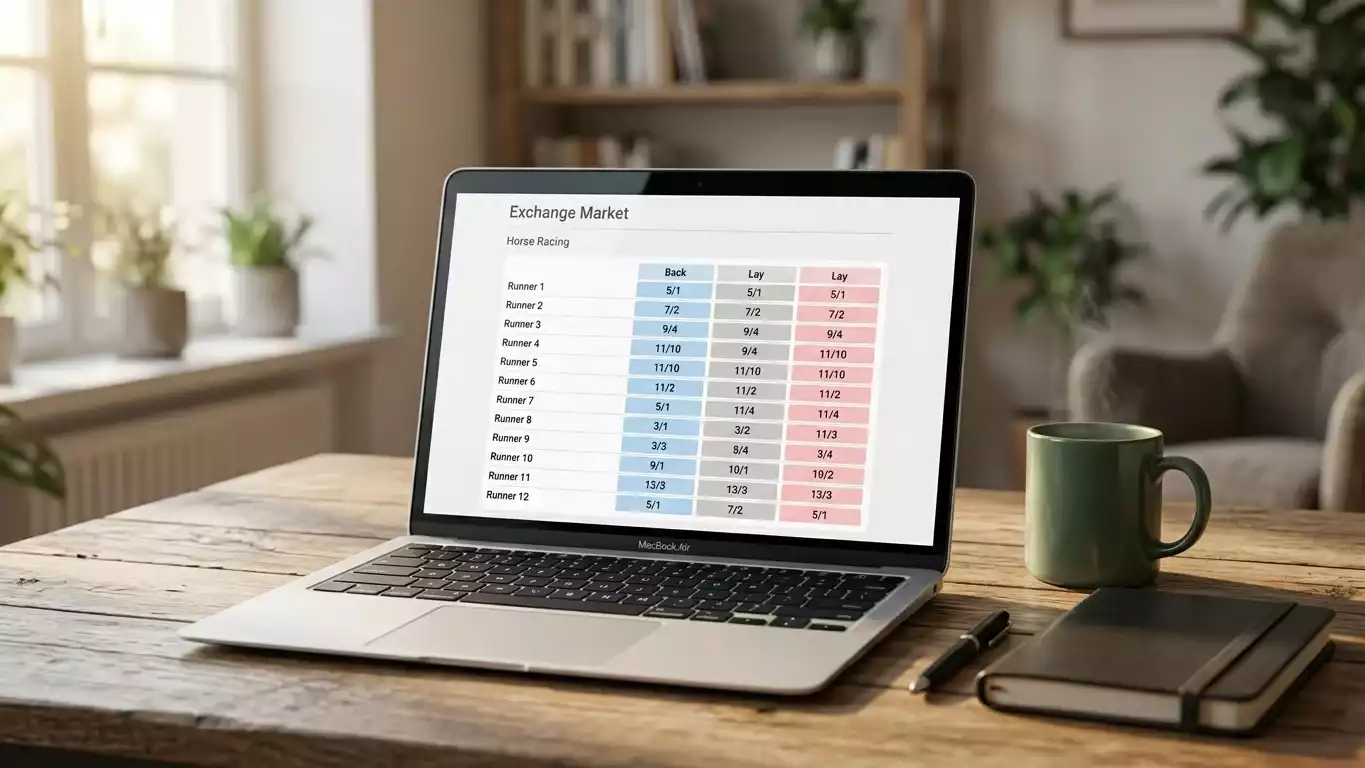
The exchange interface shows both sides of every market simultaneously. The back column shows prices you can back at; the lay column shows prices you can lay at. The two are usually one price tick apart on liquid markets, with the spread widening on illiquid markets. The matching engine fills bets at the best available price.
Commission structures across exchanges
Commission is what makes the exchange economically viable. The standard commission on the largest UK-licensed exchange is 5% of net winnings. Net winnings means your total profit on a market after settling all bets – if you bet across multiple horses in a race and win some while losing others, commission is charged on the net positive.
High-volume customers receive commission reductions through the exchange’s points system. Achieving a meaningful commission reduction requires substantial betting volume – typically hundreds of pounds in matched bets weekly. The Premium Charge applies to the very highest-volume profitable customers, and is one of the more controversial features of the largest UK exchange. Customers whose lifetime profit exceeds certain thresholds pay a percentage of their weekly net winnings on top of standard commission. The exact structure is complex and the headline numbers are far higher than most casual users realise.
Smaller exchanges have tried to compete on commission, offering 2% or 3% headline rates. The trade-off is liquidity – smaller exchanges have thinner matching pools, which means worse fill rates and wider spreads on less popular markets. Liquidity beats headline commission rate on every market except the very most liquid ones.
Trading in-running – green-up and green-out
The exchange allows trading. You can back a horse at one price, then lay it at a shorter price after the market has moved, locking in a profit regardless of the race result. The technique is sometimes called “green-up” because the exchange interface shows the locked-in profit as a green positive number across all possible outcomes.
Trading in-running – during the race – is a specialised activity. The prices move sharply as horses’ positions change, and the matching engine handles in-running trades at a slight delay to avoid pricing errors during fast market movements. Successful in-running trading typically requires good video access (a stream of the race that is not behind the live odds feed by more than a second or two), fast software, and a clear idea of when to take the trade.
Green-out is the same concept applied to losing positions. If you backed a horse at 5.0 and it has drifted to 8.0, you can lay it at 8.0 to cut your losses to a known amount regardless of whether it wins or loses. The technique is the exchange equivalent of cash-out on a sportsbook, but with prices that reflect real market liquidity rather than a bookmaker’s algorithmic offer.
Why exchanges lost £37m of GGY
“Forcing punters to hand over bank statements isn’t ‘frictionless’; it’s intrusive and will drive customers to the illegal market, where there are no safeguards at all,” is how Grainne Hurst, CEO of the Betting and Gaming Council, framed the consequence of affordability checks. The exchange’s customer profile – older, wealthier, more sophisticated, often staking four-figure sums on individual races – was the demographic most likely to refuse to provide bank statements. They could afford the stakes; they were not going to share the documents.
The Boxing Day 2024 pre-off Betfair Exchange win market dropped from £13,031,239 in 2023 to £11,216,744 in 2024, a 14% drop in a single high-profile fixture. That drop is the visible signature of high-rollers either exiting the market entirely or moving to offshore platforms where no affordability checks apply. A 2026 European Gaming UK Bettor Survey found that 89.5% of bettors spending more than £500 a week said their betting experience had worsened – that is the exchange’s natural customer base, and they are voting with their wallets.
The exchange market is still viable. It is still the best venue for disciplined value bettors and for laying as part of a portfolio strategy. But the high-roller liquidity that made the exchange a genuine alternative to the fixed-odds book has shrunk significantly, and the recovery from that shrinkage is not yet visible in the data.
For the regulatory drivers behind the exchange decline, the affordability checks guide covers the policy framework in detail.
Common questions about exchange betting
What is the Premium Charge on exchange winnings?
The Premium Charge is an additional fee applied to the very highest-volume profitable customers on the largest UK exchange. The exact threshold and rate vary, but the effect is to push effective commission on winning weeks well above the headline 5% for customers who are consistently profitable in large amounts. The charge is structured to incentivise volume rather than pure profit, which is why it primarily affects the most sophisticated users.
How does exchange SP work?
Exchange SP is the price at which a matching engine settles bets placed at SP at the moment the race starts. It is calculated by matching unmatched back and lay orders at the off, producing a single price. Exchange SP is usually slightly longer than fixed-odds SP because the exchange is not building margin into the price – only commission on the net result.
Can I lay against my own ante-post position?
Yes, and this is one of the most useful exchange techniques. If you have backed a horse ante-post at 10/1 and it shortens to 4/1 ahead of the race, you can lay the horse at 4/1 on the exchange to lock in profit regardless of the result. The technique requires the exchange market to be liquid enough to match your lay, which is rarely a problem for festival ante-post favourites.
Written by the editors at Bets Horse Racing.