
Accumulator Bets on UK Horse Racing: Six Selections, One Slip, Long Odds
 Available in US
Table of Contents
- The slip that excites and disappoints
- Why accumulators are bookmaker favourites
- The maths of the four-fold
- Each-way accumulators and the place portion
- Bet builders, request-a-bet and the new generation
- Where accumulators actually work
- The Cheltenham accumulator and the festival market
- Stakes, bankroll and the variance trap
- Questions punters ask about accumulators
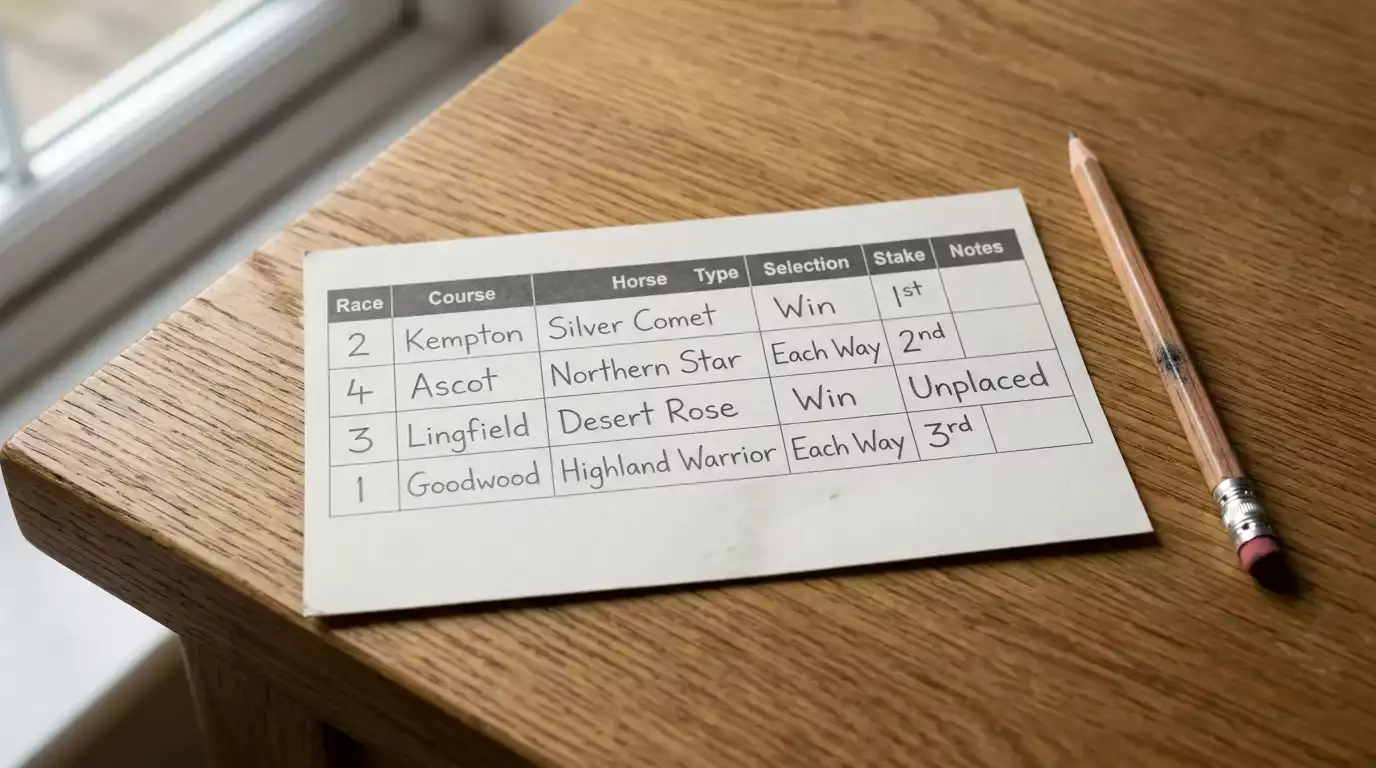
A friend of mine once turned a £2 stake into £1,847 with a six-horse Saturday accumulator. He had spent the previous fifteen years losing more or less the same amount in £2 increments on similar slips. The maths of accumulators is brutally honest – they offer enormous variance and almost always negative expected value, and the people who profit are the people who collect, not the people who bet.
The slip that excites and disappoints
An accumulator is a single bet covering multiple selections, where every selection must win for the bet to pay out. The odds compound across the selections, which is why a six-horse acca at modest individual prices can return a four-figure payout from a coffee-cup stake. The compound is also why most accumulators lose. One selection at 5/1 wins roughly one time in six. Six selections each at 5/1 all winning together is the maths of an event that happens roughly one time in 46,656.
The slip itself is straightforward to construct. Pick your races. Pick a horse in each. Choose how many “legs” – selections – to combine. Stake your unit. The bookmaker multiplies the prices together to give you a total return for a winning slip. A £5 double on two horses at 4/1 each returns £125 plus stake (5/1 × 5/1 = 25/1). A £5 treble at the same prices returns £625 plus stake. A £5 six-fold returns £78,125 plus stake. The geometry is intoxicating.
Why accumulators are bookmaker favourites
The bookmaker margin compounds across an accumulator in exactly the same way the prices do. A single bet at 5/1 with a 5% overround pays back about £4.76 for every £5 staked on average – the bookmaker takes 5%. A six-fold at the same prices and the same per-race overround compounds the margin to a take of roughly 26%. For every £5 staked on the six-fold across a large enough sample, the bookmaker keeps £1.30. That is not a betting product. That is a slow-motion donation.
Accumulators are the highest-margin product the bookmakers sell on UK racing, which is why they push them so hard with promotions, bet-builders and “Saturday accumulator” front-page tiles. The marketing is built around the rare big win – the £2-into-£1,800 stories that go on social media – and not around the typical outcome, which is the £2 evaporating with no return on roughly 95% of slips.
The bookmaker margin on accumulators is one of the structural reasons UK racing remains profitable for the operators despite the broader decline in turnover. Total betting turnover across British racing dropped 4.2% over the first nine months of 2025 and sits 12.8% below the equivalent period in 2023, but the margin on the remaining turnover has held up partly because punters have shifted increasingly toward higher-margin products like accumulators and bet-builders.
The maths of the four-fold
To make the abstract concrete, walk through a typical Saturday four-fold. Four selections, average price 3/1 each. Each individual horse has roughly a 25% chance of winning a fair market. Compounding: 0.25 × 0.25 × 0.25 × 0.25 = 0.0039, or about 0.4%. The fair price on the four-fold is roughly 256/1.
The bookmaker will quote roughly 255/1 if the overrounds are tight, or sometimes lower as 200/1 if margins are wider. A £10 stake at 256/1 returns £2,560 plus stake on a winning slip. Across a hundred such slips at fair prices, the average punter wins one and loses ninety-nine, returning £2,570 against £1,000 staked – a positive expected value of 157%. Across a hundred slips at 200/1 (with the typical operator margin), the average punter wins one and loses ninety-nine, returning £2,010 against £1,000 staked – still positive EV at 101%.
The maths looks rosy until you account for the assumption that each horse has a fair 3/1 chance. Most punters do not pick four horses at 3/1 that are individually fair value. They pick four favourites with the bookmaker’s margin already in each price, and the compound margin chews through the headline return. The realistic outcome on a four-fold of bookmaker-priced favourites is closer to break-even than to positive EV, which means the variance dominates the expectation and most punters lose over time.
Each-way accumulators and the place portion
Each-way accumulators are the version of the bet that has structural value in some configurations. An each-way slip is really two separate accumulators in one – a win accumulator paying out only if every selection wins, and a place accumulator paying out if every selection finishes in the placings. The place portion compounds at the each-way fraction (usually one-quarter or one-fifth the odds depending on the race), but the probability of each leg placing is much higher than the probability of winning, so the place accumulator hits more often.
The trade-off is that the place accumulator pays much smaller. A four-fold each-way at average 3/1 with each-way at one-quarter the odds pays the place portion at roughly (3/4)^4 = 32% of the win-portion return. On a £10 each-way bet at 3/1 × 4, the place portion pays roughly £30-50 even when all four place, depending on terms. The win portion, when it hits, pays £2,560 plus the £10 win-stake portion.
For festival meetings with big fields and extra-places promotions, each-way accumulators get genuinely interesting. A four-fold across Cheltenham handicaps with bookmakers paying six or seven places at one-quarter the odds can produce slips where the place portion alone is a small but reliable profit, and the win portion is a low-probability lottery on top.
Bet builders, request-a-bet and the new generation
The acca’s modern cousin is the bet builder – a customised multi-leg slip within a single race or across multiple races, with bookmaker-priced individual legs and a customised final price. Bet builders let punters combine outcomes like “Horse A wins” and “Horse B finishes top three” and “Horse C beats Horse D” into a single slip with a custom acca price.
The margin on bet builders is the highest of any product the bookmakers sell on racing. Because each leg is custom-priced by the operator’s risk model rather than by an open competitive market, the operator has full control over the implied probabilities. Punters who use bet builders frequently are typically paying a 30-40% effective margin across their slips – which is fine if you understand the cost and bet for entertainment, but actively destructive if you bet on bet-builders to make money.
The marketing push behind bet builders is intense and well-funded, and they account for a growing share of UK racing turnover among casual punters. Industry data suggests bet-builder products now represent around 15-20% of all online racing bets placed by recreational punters, up from negligible levels five years ago. The shift is structurally good for the operators and structurally bad for the punters.
Where accumulators actually work
There are configurations of accumulator that retain genuine value if used carefully. Doubles and trebles on price-driven horses with shortcomings the casual market under-weights – the kind of selections you would back individually anyway – combined for slightly above-fair compound returns. The maths gets less brutal at two or three legs because the compounded margin is smaller and the variance is more manageable.
Saturday “lucky” multi-bets – Lucky 15, Lucky 31, Lucky 63 – bundle multiple permutations of doubles, trebles and four-folds (or higher) into a single stake. They cost more per unit because they are effectively multiple accumulators stacked together, but they hedge against the all-or-nothing problem of straight accas. A Lucky 15 on four horses at average 3/1 each returns something even on a single winner, more on doubles, more on trebles and the full payout on a four-timer. The variance is meaningfully reduced.
The trade-off is the stake. A £1 Lucky 15 costs £15 (four singles, six doubles, four trebles, one four-fold). The compounding margin still works against you, but the structure protects you from the cliff-edge variance of a straight four-fold. For Saturday punters who enjoy the multi-bet experience without the boom-or-bust outcome, Lucky bets are the most defensible version of the acca family.
The Cheltenham accumulator and the festival market
Festival weeks are when accumulators bring in their highest volumes. Cheltenham 2025 saw bookmakers like William Hill forecasting £450m total turnover and the actual contribution from multi-leg slips was substantial. The casual punter mindset at a festival is “pick a horse in each race, combine them” – and the structure of the festival, with all 28 Cheltenham races appearing in the top 31 of 2025 by individual race turnover, encourages exactly that behaviour.
The bookmaker’s market for festival accas is finely calibrated. The “all winners” jackpots and the bonus payouts for hitting four-folds, five-folds and six-folds across the day are designed to look like generosity but actually anchor punter behaviour around the most profitable products. Festival bonuses generally work as marketing rather than as genuine value transfer – the bonus pool is built into the operator’s overall margin on the festival book.
The most useful framing for a festival accumulator is to treat it as paid entertainment. Pick four or five horses you would have backed anyway, combine them in a small-stakes acca, accept that the slip will almost certainly lose, and enjoy the running. The Cheltenham Festival betting guide covers the day-by-day structure for punters planning the week.
Stakes, bankroll and the variance trap
The single most important rule about accumulator betting is bankroll discipline. The variance on a four-fold or higher is enormous compared to single-bet variance, and the temptation to chase losses by increasing stakes after a near-miss is sharp. Punters who stake 1-2% of their bankroll per accumulator slip generally survive the variance. Punters who stake 10% or more are betting on a product that is structurally negative-expectation with high variance, and the maths will catch up with them sooner rather than later.
The other rule is to keep records. The dopamine memory of accumulators is famously selective – punters remember the £18 win and forget the previous twenty £5 losses that funded it. A simple spreadsheet of slip stakes and returns over a season tells the honest story. For most punters who track properly, the truth is that accumulators are a paid hobby rather than a profit centre, and recognising that puts the stakes into the right perspective.
Questions punters ask about accumulators
How many selections is too many for an accumulator?
Past five or six legs, the compound margin and variance make accumulators genuinely a lottery product. A seven-fold of bookmaker-priced favourites at average 3/1 has roughly a 1 in 16,000 chance of winning and the margin compounded into the price is typically 30% or more. Doubles and trebles retain more rational expected value if the selections are genuinely value individually.
Do accumulator bonuses make the bet better value?
Bonus offers – extra payouts for hitting a four-fold or five-fold – sweeten the headline return but are usually built into the operator’s overall margin rather than reducing it. A 25% bonus on a four-fold that already carries 25% compound margin returns the product to roughly break-even on expected value, which is no worse than a single bet but no better either.
Is a Lucky 15 better than a four-fold?
Yes, structurally – the Lucky 15 spreads the stake across 15 permutations and pays returns on any combination of doubles, trebles or the full four-fold. The trade-off is the per-slip stake (£15 for a £1 Lucky 15) but the variance is much lower than a single £15 four-fold and the all-or-nothing risk is removed.
Created by the ”Bets Horse Racing” editorial team.