Decoding UK Racecards: Form, Ratings and Going
 Available in US
The first racecard I ever held belonged to my grandfather, who folded it into quarters and scribbled in the margins with a stubby pencil. I was eight, and I thought the little numbers next to each horse were prices. They were not. They were form figures, and they were quietly telling me which horses had been pulled up at the last fence, which had won by ten lengths, and which had not been seen on a track for fourteen months. I learned to read them properly only ten years later, after losing a fair few quid assuming “1” meant “first choice” instead of “first place last time out”.
A UK racecard is a compact database. Every column on it has been standardised by the British Horseracing Authority, every abbreviation has a fixed meaning, and once you can decode the lot you stop guessing and start reading. This walkthrough takes the card line by line, the way I wish someone had done for me at eighteen.
Interpreting Race Headers: Distance, Class, and Going Metrics
Before you even reach the runners, the top of the racecard is doing real work. Most punters scan past it. That is a mistake. The header tells you what kind of race this is, and the answer changes how you read everything below.
Distance comes first, in miles and furlongs – five furlongs is a sprint, two miles plus is a stayer’s trip. Then surface, which in Britain means turf at one of 59 licensed racecourses, and going, the official description of how soft the ground is. Class follows, anywhere from Class 1 at the top to Class 7 at the bottom, and prize money sits next to it. Total prize money across British racing in 2025 rose by £4.7m to £153m, but it is unevenly spread – a Class 1 race might offer £100,000 to the winner while a Class 6 sells for under £4,000. The header tells you which end of the spectrum you are looking at.
You will also see the race name, the age band – “3yo+” means three-year-olds and older – and the weight conditions. “Handicap” in the header means the BHA’s handicapper has assigned each horse a weight to equalise their chances. “Conditions” or “novices” means the weights are set by rules, not by individual rating. If you see “Listed” or “Group 1/2/3” beside Class 1, you are looking at the top of the British pyramid. There are roughly 1,460 fixtures across British racecourses each year, and the headers are how I work out which ones deserve real attention.
Runner rows: cloth number, draw, age, weight, jockey
I once spent an entire afternoon at Goodwood backing a horse I thought was drawn five. It was drawn fifteen. By the time the stalls opened, that error had already cost me – high draws at Goodwood over five furlongs on soft ground are not where you want to be. Reading the row properly is not optional.
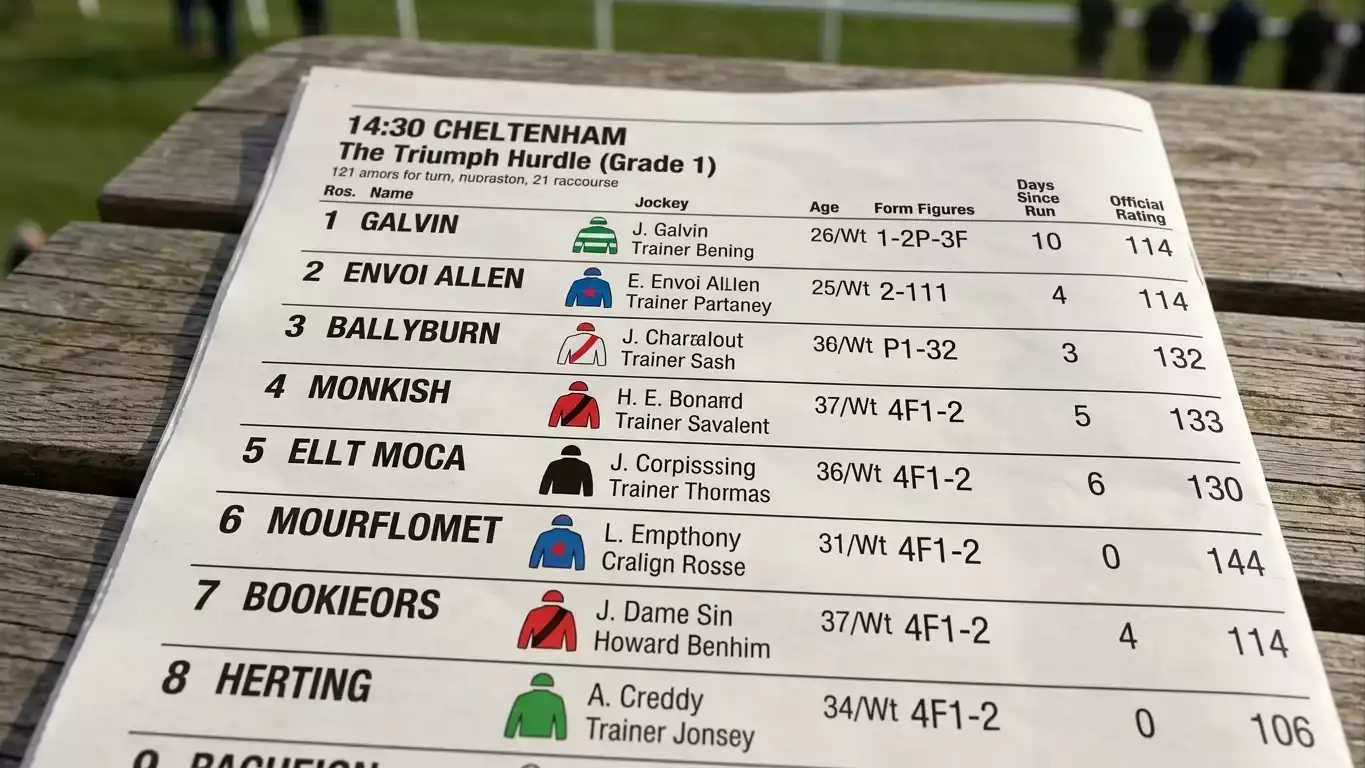
Left to right, here is what you get. The cloth number is the saddle-cloth number, which matches the runner on the screen and the announcement at the off. Next to it, the draw – the stall number from which the horse breaks. On flat tracks this matters enormously. On jumps, it is decorative. After the draw comes the horse’s name, often with letters in brackets: (IRE) means bred in Ireland, (GB) in Britain, (FR) in France. Then the trainer, the form figures, the age, and finally the weight in stones and pounds.
The jockey usually sits at the right of the row, sometimes with a “(3)” or “(5)” or “(7)” beside the name. Those are claim allowances – apprentice or conditional jockeys who reduce the horse’s weight by that many pounds. A 7lb claimer on a horse rated at the bottom of a handicap is sometimes a real edge, sometimes a red flag that the trainer could not get a senior rider. Context decides which.
The age column matters more than novices realise. In flat racing, three-year-olds get weight concessions from older horses through the weight-for-age scale until late in the season. In jumps, the prime is usually seven to nine for chasers, and a ten-year-old novice chaser is the kind of red flag that should make you reread the form three times.
Decoding form figures: 1-PU-2F
The form string is the row that earns its keep. It reads right to left in time – the most recent run is on the right, the earliest on the left. So “1-PU-2F” tells you the horse, reading backwards, finished first two starts ago, pulled up last time, was second the run before that, and fell most recently. Or, depending on the publication, the other way round. Always check the publication’s house style at the top of the card.
The dashes have meaning too. A single dash separates this season from last. So “23-451” means a horse that was second and third last season, then fourth, fifth and won this term. A “/” usually marks a calendar year break – two slashes mean two seasons off. That kind of gap is worth noticing. A horse coming back after fourteen months has plenty to prove on its first run.
Numbers above 9 are usually shown as “0” – so a “0” in a form string does not mean unplaced specifically, it means finished tenth or worse. You have to dig into the past performance lines for the real number. Letters appear in place of numbers when something went wrong: F for fell, U or UR for unseated rider, P or PU for pulled up, R or RR for refused to race, B or BD for brought down, S for slipped up. Each of those has a different story behind it. A faller is different from a horse pulled up exhausted. The form string compresses both into a single character, and the rest of the work is yours.
OR, RPR and Topspeed – three numbers, three philosophies
Pick up any decent racecard and you will see three rating columns next to each horse. They look similar. They are not the same thing, and treating them as interchangeable is one of the fastest ways to lose money. There are 21,728 horses in training in Britain in 2025 – every single one of them carries an OR, and a fair proportion carry RPR and Topspeed numbers too.
OR is the official rating, set by the BHA’s handicapper. It is the number that determines the weight a horse carries in handicaps. Rises and falls are deliberate – a winning run typically earns a rise of three to ten pounds, a string of poor efforts produces drops. The handicapper’s view is the basis of the entire handicap system, and the OR column is the one that pays your bills if you understand it.
RPR is the Racing Post Rating, produced privately by their handicappers. It tends to react more quickly to form changes than the OR, and it can be a useful tell when the BHA’s handicapper is “behind” – meaning a horse looks much better than its OR suggests. Topspeed is a time-based figure. It tries to capture how fast a horse ran in absolute terms, adjusted for going and distance. It rewards runners who post good clock times even when they lose, which is where the value sometimes hides.
If all three agree, the horse is what the form says it is. If they disagree, that is where I start asking why.
NR, WD, UR, PU, F – what each abbreviation costs you
A non-runner is not a non-event for your wallet. The two letters next to a horse’s name on the day, or the three letters in a form line from a previous race, change what you should expect. They are also the codes where most newcomers lose track of the rules.
NR means non-runner, declared before the off. Your stake on a non-runner is returned, but if you backed it in a multiple, the bet runs on at SP on the remaining selections, often with a Rule 4 deduction applied to the other horses in the same race. WD means withdrawn – usually before final declarations – and the stake comes back. PU is pulled up by the jockey, often because the horse is tiring badly or has a problem. UR means unseated rider. F is fell. BD is brought down. Each is a “loss” in betting terms – the stake is gone – but each tells a different story about the horse next time.
A horse that fell at the last when leading is, in racing terms, a different animal from one that was pulled up at halfway. The form string compresses both into a single character. Reading the comments in the past performance lines is the only way to separate them. If you cannot find the comment, you cannot trust the form line. It is that simple.
If you want to get deeper into what each in-running code does to your stake, the payout-by-code breakdown is the next stop. I keep that page open in a tab on busy Saturdays.
Common racecard questions
What does the small ‘v’ or ‘b’ next to a horse name mean?
Those are headgear codes. ‘v’ means visor, ‘b’ means blinkers, ‘p’ means cheekpieces, ‘h’ means hood, ‘t’ means tongue tie. A small ‘1’ after the letter means first time wearing that piece of equipment – often a useful signal that the trainer is trying to focus the horse’s attention or solve a specific behavioural issue.
Why does the same horse have different ORs on different cards?
The BHA’s handicapper updates the OR weekly, usually on Tuesdays. If you compare a card printed Saturday morning with one printed Wednesday afternoon, you may see a different rating for a horse that ran in between. The OR shown on the day of the race is the one that determines the weight carried.
Written by the editors at Bets Horse Racing.